
WorldLink Labs · GRC Platform · 2025–2026
GRC Platform Design: Simplifying Complex ComplianceWorkflows
An AI-powered GRC platform that unifies compliance
workflows, risk analysis, and system insights into a scalable,
intuitive enterprise experience.
Role
Lead UX / Product Designer
Company
WorldLink
Duration
6 Months
Platform
Web · Enterprise SaaS
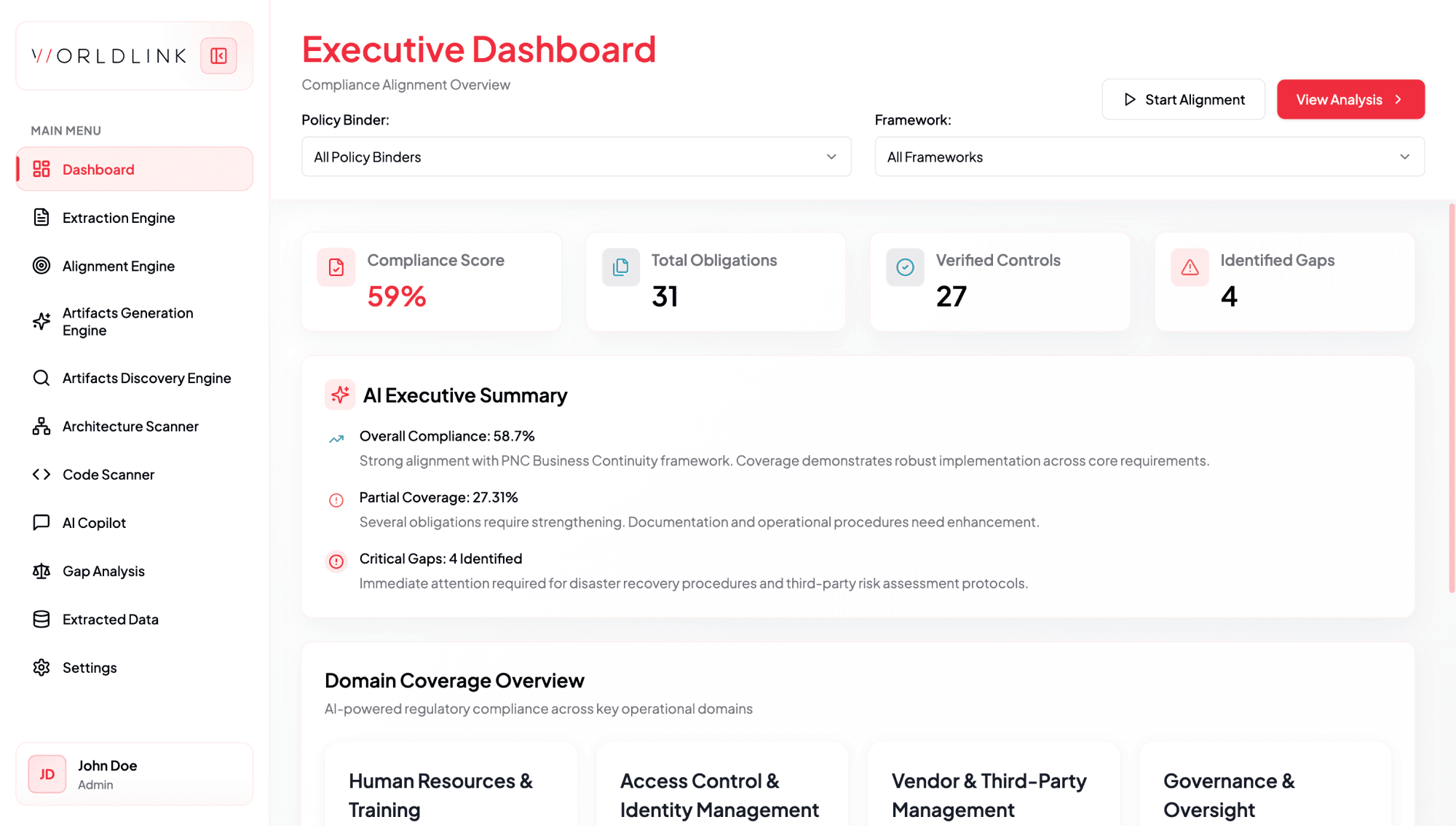
GRC-Enterprise.com
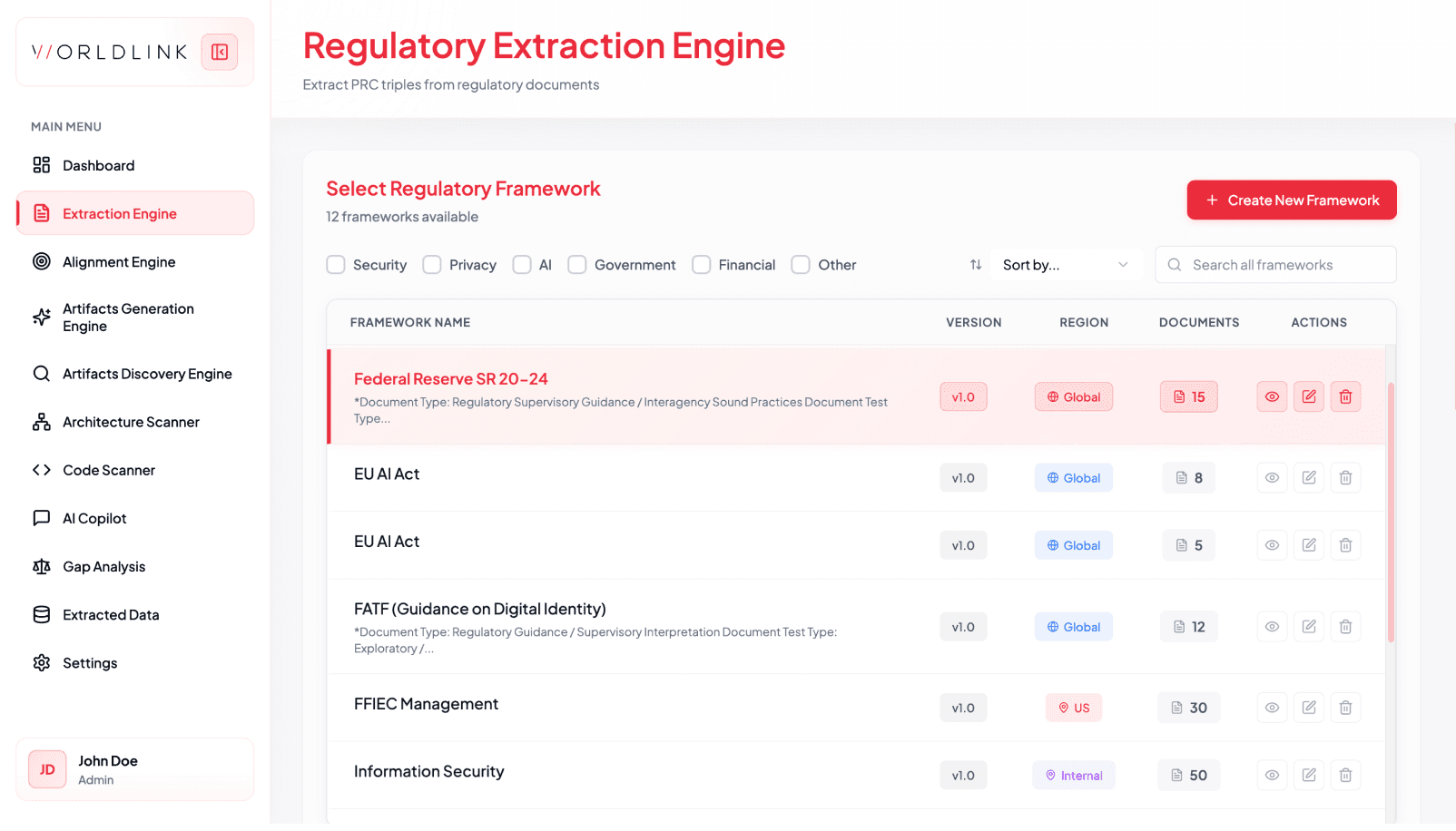
GRC-Enterprise.com
Want to skim through this case study? I got you covered.
Here's a 1 min TL;DR Version.
Designed the end-to-end UX for an AI-driven compliance platform, helping compliance officers, risk managers, and security teams navigate complex enterprise workflows with clarity and ease.
Compliance Officers
Risk Managers
Security Architects
Enterprise Orgs
WorldKit Design System
What did I do?
Led end-to-end UX across multiple modules
with a shared WorldKit design system.
Artifacts Generation Engine
Extraction Engine & Extracted Data
Alignment Engine
Gap Analysis
Architecture Scanner
Code Scanner
Artifacts Discovery Engine
Why was it done?
Compliance teams were drowning in
fragmented tools and manual
workflows. They needed one unified
platform with AI automation to cut
review cycles from days to hours.
What did I learn?
Designing for AI-heavy enterprise tools
requires balancing automation
confidence with human oversight.
"Remove what you don't need" is as
important as "add what users want."
The Impact
|
Measurable results within weeks of launch
Manual Effort ↓
74%
74%
Reduction in manual compliance effort
Feature Adoption
91%
91%
AI feature adoption in first 2 weeks
Satisfaction Score
4.7
4.7
★
User satisfaction score post-launch
The problem
What was broken?
Compliance teams were managing fragmented, time-intensive workflows across too many disconnected tools with zero AI assistance and no unified visibility.
Pain 01
Regulatory Fragmentation
Compliance officers managed 5–10+ frameworks manually each with its own spreadsheet, folder, and tracking method. Cross-framework visibility was essentially impossible.
Pain 02
Manual Document Processing
Extracting obligations from regulatory PDFs required analysts to manually tag hundreds of pages. A single document took 2–3 days. There was no automation, no speed.
Pain 03
No Real-Time Gap Visibility
Gaps were only discovered during audits — never
proactively. No live scoring, no early warning, no
executive summary non-technical stakeholders
could act on in 30 seconds.
Pain 04
Zero AI Assistance
Despite large volumes of compliance data, tools lacked AI-driven insights, automation, and natural language querying, forcing teams to rely on institutional knowledge.
THE SOLUTION
Rather than patching existing workflows, we reimagined the entire compliance
experience from the ground up — building a unified, AI-native platform where every
module speaks the same design language and shares one source of truth.
Unified Platform
AI-Assisted Extraction
Real-Time Visibility
WorldKit Design System
Enterprise-Grade UX
One platform. Six engines.
Zero compliance blind spots.
We structured the platform around six interconnected modules — each solving a distinct pain point, yet unified under a consistent interaction model and shared design system. The result: compliance teams could move from document upload to actionable insight in minutes, not days.
MODULE 01
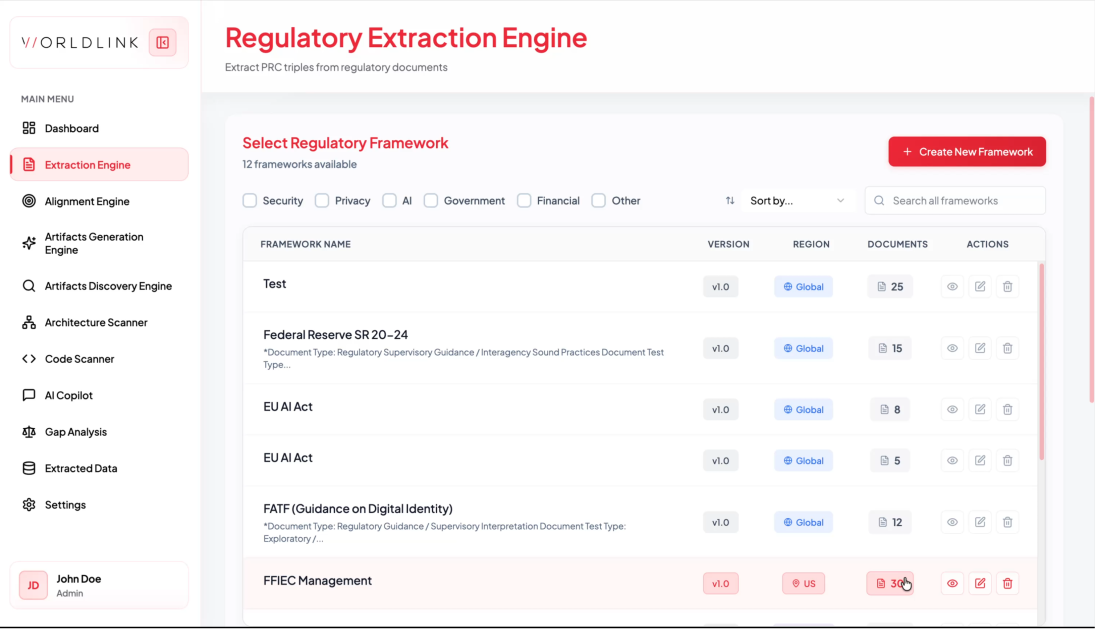
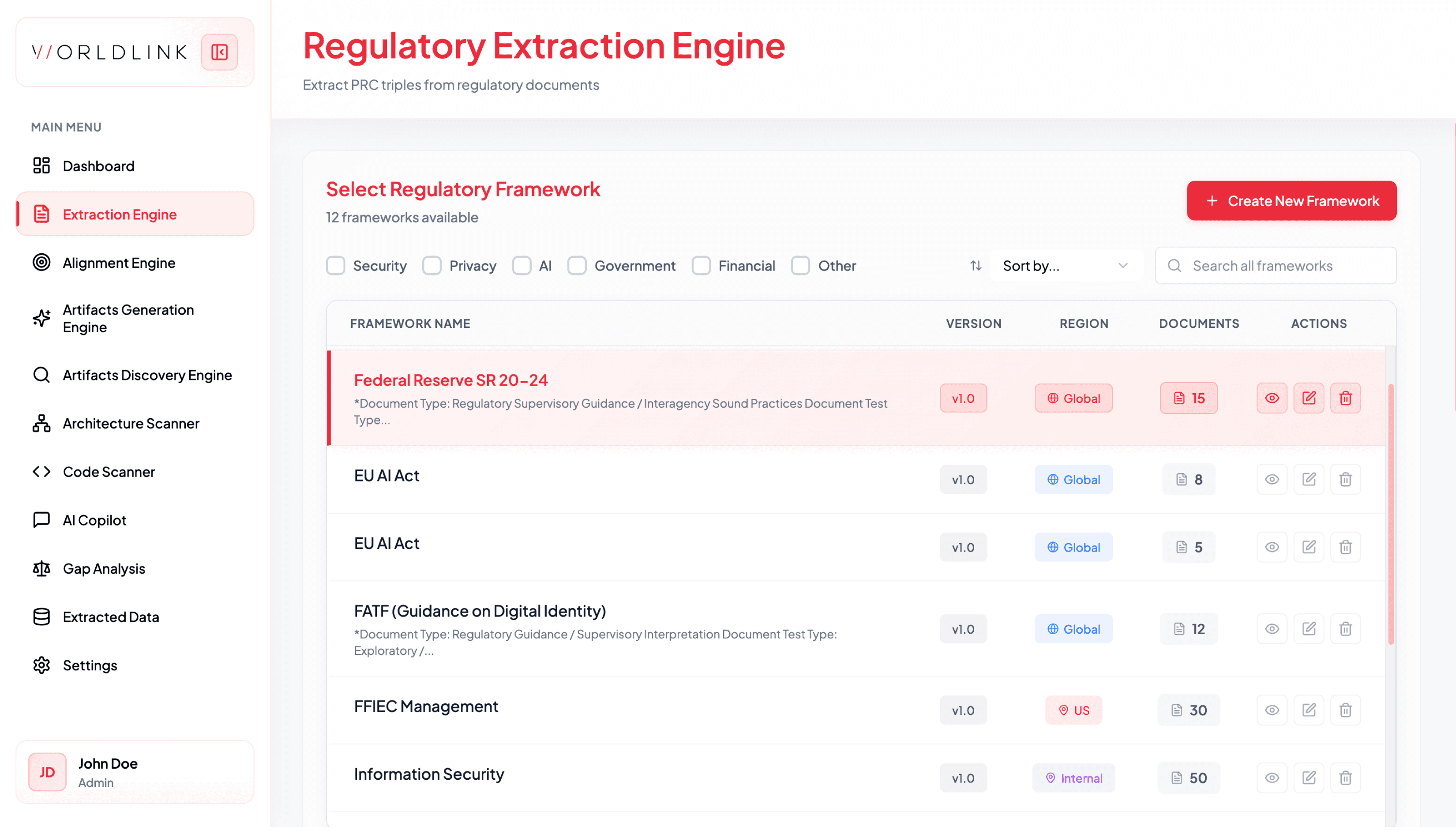
Regulatory Extraction Engine
The first bottleneck: analysts spending 2–3 days manually tagging obligations inside dense
regulatory PDFs. We replaced this with an AI-assisted extraction pipeline surfaced through a clean
review interface turning document processing into a structured, auditable workflow.
GRC-Enterprise.com
AI extraction from regulatory PDFs
in under 60seconds
Human-in-the-loop review with
inline accept / reject
Severity auto-classification: Critical → Low
Export as structured obligation
register (CSV /JSON)
Design decision: We deliberately kept the review table minimal — no modal
overload. Analysts can triage 50+ obligations in a single scroll session with
keyboard-accessible actions.
MODULE 02
Alignment Engine
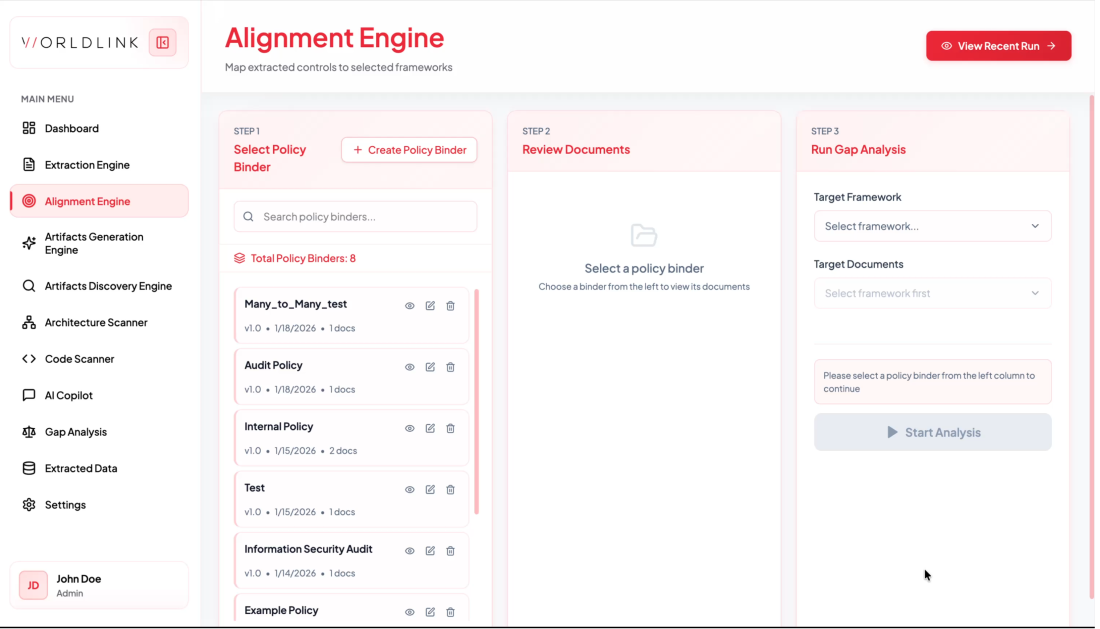
Enterprises rarely comply with just one framework. The Alignment Engine intelligently maps
controls across SOC 2, ISO 27001, NIST CSF, GDPR and others — surfacing overlap and
eliminating redundant compliance work.
GRC-Enterprise.com
Automated cross-framework control mapping
Overlap detection to reduce redundant work
Visual coverage heatmap per framework
Custom framework imports via CSV/JSON
MODULE 03
Artifacts Generation Engine
Compliance artifacts — policies, procedures, evidence packs — were previously assembled by
hand over weeks. We designed an AI-generation flow that produces structured draft artifacts from
extracted obligations, mapped to the appropriate framework controls.
GRC-Enterprise.com
One-click generation of policy and procedure
drafts
Auto-linked to relevant framework controls
Approval workflow with role-based permissions
Version history with diff tracking
MODULE 04
Gap Analysis
Gaps were only discovered during audits — far too late. We redesigned gap detection as a
continuous, real-time layer surfaced through an executive-readable dashboard. No more surprises
on audit day.
WorldLink GRC — Gap Analysis Dashboard
GRC Platform
Dashboard
Extraction
Artifacts
Alignment
Gap Analysis
— Overview
— By Domain
— Remediation
Architecture
Code Scanner
Compliance Gap Summary
3 critical open
Overall Score
78%
↑ 12% vs last audit
Critical Gaps
3
require immediate action
Days to Audit
42
SOC 2 renewal
Domain
Gap
Risk
Owner
Due
Access Control
No MFA on legacy VPN
Critical
IT Ops
3d
Data Retention
No automated purge policy
High
Legal
12d
Incident Mgmt
IR plan untested 18 months
Critical
SecOps
7d
Vendor Risk
3rd party assessments overdue
Medium
Procurement
30d
The hardest design challenge here was making severity feel urgent without
triggering alert fatigue. We used color sparingly — red only for items within 7-day
risk windows — and moved "days remaining" into the primary column.
Real-time gap scoring against active
frameworks
Remediation ownership assignment per gap
Exec-facing summary dashboard (30-second
read)
Auto-escalation when SLA breaches approach
MODULE 05
Architecture Scanner
Security architects needed a way to validate infrastructure against compliance requirements
without generating a 200-page report nobody reads. We designed a scannable, interactive
architecture view that highlights risk directly on the system diagram.
WorldLink GRC — Architecture Scanner
GRC Platform
Dashboard
Extraction
Artifacts
Alignment
Gap Analysis
Architecture
— Diagram
— Findings
Code Scanner
System Architecture — Risk View
2 findings
Live Architecture Map
Internet
Load Balancer
⚠ TLS 1.0 active
API
Gateway
Auth
Service
⚠ No MFA
App Servers
Database
AES-256 ✓
⚠
Load Balancer — TLS 1.0 Active
Violates SOC 2 CC6.7. Upgrade to TLS 1.2+ required. Maps to 2 open obligations.
Critical
!
Auth Service — MFA Not Enforced
Privileged access without MFA. ISO A.9.4.2 gap. Remediation owner: IT Ops.
High
Import architecture via Terraform / draw.io /
manual
Risk overlay directly on architecture diagram
nodes
Auto-link findings to obligations and controls
One-click remediation ticket generation
MODULE 06
Code Scanner
The final frontier: compliance visibility at the code level. The Code Scanner lets security teams
detect misconfigurations, hardcoded secrets, and non-compliant patterns inside the codebase
itself — without requiring developers to leave their workflow.
WorldLink GRC — Code Scanner
GRC Platform
Dashboard
Extraction
Artifacts
Alignment
Gap Analysis
Architecture
Code Scanner
— Scan
— Findings
— History
Latest Scan — main branch
4 issues found
Files Scanned
1,284
across 8 repos
Secrets Detected
2
hardcoded tokens
Scan Duration
48s
last run 2h ago
🔑
Hardcoded AWS key — auth/config.py:L142
AWS_SECRET_ACCESS_KEY exposed. Violates SOC 2 CC6.1. Immediate rotation
required.
Critical
🔑
DB password in plaintext — db/connect.js:L28
Database credentials not using secrets manager. Maps to ISO A.10.1.1.
Critical
!
Logging disabled — api/payments.js:L87
Transaction logging suppressed. SOC 2 CC7.2 requires full audit trail.
High
!
Unencrypted field — models/user.py:L204
PII field `ssn` stored without encryption. GDPR Art. 32 violation.
High
Deep scan across 10+ languages and
frameworks
Auto-mapped findings to compliance
obligations
CI/CD integration — scan on every PR
Developer-friendly inline fix suggestions
DESIGN PRINCIPLES
The thinking behind every screen.
Every module was built on three non-negotiable design principles — distilled from
hours of compliance officer shadowing sessions and workflow analysis.
Principle 01
Progressive Disclosure — don't show what they don't need yet
Compliance officers drown in data. We applied ruthless hierarchy: surface the most critical items
first, then let users drill in. Every screen has a "30-second executive version" and a "full analyst
view."
Principle 02
Human-in-the-loop — AI assists, humans decide
Every AI-generated output is surfaced as a draft pending human review. We intentionally never
auto-approve — not because AI isn't accurate, but because compliance requires defensible human
sign-off for auditors.
Principle 03
Traceability by design — every action leaves an audit trail
Unlike consumer apps where you can hide state, enterprise compliance tools must expose their
history. We built structured changelogs, approval chains, and evidence timestamps into the core
data model — not as an afterthought.
WHAT I LEARNED
Designing for high-stakes enterprise AI.
LEARNING 01
Automation confidence ≠ automation trust
Users were impressed by AI extraction accuracy — but still wanted to manually verify every
item. The insight: trust is built through transparency, not just accuracy. We added
confidence scores and source citations to every AI output, and watch-through rates
increased significantly.
LEARNING 02
"Remove what you don't need" is as important as "add what users want"
Early prototypes had too many features on every screen. Compliance officers don't want
more data — they want the right data, faster. Our biggest UX wins came from ruthlessly
removing UI elements, not adding them. Every screen went through at least two
"subtraction" rounds.
LEARNING 03
Executive dashboards are a product unto themselves
The most-used feature turned out to be the executive summary view — a single screen with
3 KPIs and a risk heat map designed for a 30-second read by a non-technical CISO.
Designing for this audience required a completely different vocabulary, visual grammar, and
information density than designing for analysts.
"The best compliance UX is the one where users forget they're doing compliance
and just feel like they're doing their job well."
— Design retrospective note, Sprint 14
"
THE IMPACT | Measurable results within weeks of launch
74%
↓
MANUAL EFFORT
Reduction in manual
compliance effort
91%
↑
FEATURE ADOPTION
AI feature adoption in first 2
weeks
4.7
★
SATISFACTION
User satisfaction score post-
launch
WORLDLINK LABS · GRC PLATFORM · 2025–2026
Lead UX / Product Designer — Achyut Khanpara

GRC-Enterprise.com